|
Maria-Florina Balcan, Nicholas J. A. Harvey.
43rd Annual ACM Symposium on Theory of Computing (STOC 11),
San Jose, CA, June 2011.
PDF.
arXiv,
August 2010.
PDF.
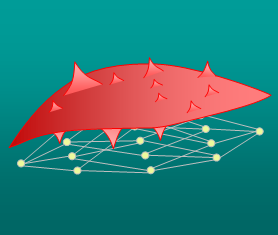 There has recently been significant interest in the machine learning community on understanding
and using submodular functions. Despite this recent interest, little is known about submodular functions
from a learning theory perspective. Motivated by applications such as pricing goods in economics, this
paper considers PAC-style learning of submodular functions in a distributional setting.
There has recently been significant interest in the machine learning community on understanding
and using submodular functions. Despite this recent interest, little is known about submodular functions
from a learning theory perspective. Motivated by applications such as pricing goods in economics, this
paper considers PAC-style learning of submodular functions in a distributional setting.
A problem instance consists of a distribution on
{0,1}n
and a real-valued function on
{0,1}n
that is non-negative, monotone
and submodular. We are given poly(n) samples from this distribution, along
with the values of the function at those sample points. The task is to
approximate the value of the function to within a multiplicative factor at
subsequent sample points drawn from the same distribution, with sufficiently high
probability. We prove several results for this problem.
-
If the function is Lipschitz and the distribution is a
product distribution, such as the uniform distribution, then
a good approximation is possible: there is an
algorithm that approximates the function to within a factor O(log (1/ε)) on a
set of measure 1-ε, for any ε>0.
-
If we do not assume that the distribution is a product distribution, then the approximation factor
must be much worse: no algorithm can approximate the function to within a factor of
O(n1/3/log n)
on a set of measure 1/2+ε, for any constant ε>0.
This holds even if the function is Lipschitz.
-
On the other hand, this negative result is nearly tight:
for an arbitrary distribution, there is an algorithm that approximates
the function to within a factor of
n1/2
on a set of measure 1-ε.
Our work combines central issues in optimization (submodular functions and matroids) with central
topics in learning (distributional learning and PAC-style analyses) and with central concepts in pseudorandomness
(lossless expander graphs). Our analysis involves a twist on the usual learning theory models
and uncovers some interesting structural and extremal properties of submodular functions, which we
suspect are likely to be useful in other contexts. In particular, to prove our general lower bound, we use
lossless expanders to construct a new family of matroids which can take wildly varying rank values on
superpolynomially many sets; no such construction was previously known.
|
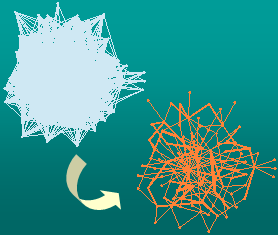 Recently there has been much interest in "sparsifying"
sums of rank-one matrices:
modifying the coefficients such that only a few are nonzero,
while approximately preserving the matrix that results from the sum.
Results of this sort have found applications in many different areas,
including sparsifying graphs.
In this paper we consider the more general problem of sparsifying
sums of positive semidefinite matrices.
We give several algorithms for solving this problem and
describe several applications of these algorithms.
Recently there has been much interest in "sparsifying"
sums of rank-one matrices:
modifying the coefficients such that only a few are nonzero,
while approximately preserving the matrix that results from the sum.
Results of this sort have found applications in many different areas,
including sparsifying graphs.
In this paper we consider the more general problem of sparsifying
sums of positive semidefinite matrices.
We give several algorithms for solving this problem and
describe several applications of these algorithms.
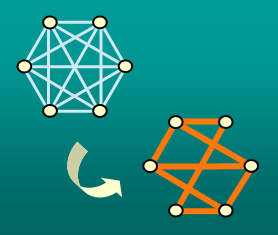 We present two new approaches to constructing graph sparsifiers -- weighted subgraphs
for which every cut has the same value as the original graph, up to a factor of (1 ± ε).
The first approach independently samples each edge uv with probability
inversely proportional to the edge-connectivity between u and v.
The fact that this approach produces a sparsifier resolves an open question
of Benczur and Karger.
Concurrent work of Hariharan and Panigrahi (2010) also resolves this question.
The second approach samples uniformly random spanning trees.
Both of our approaches produce sparsifiers with
O(n log2(n)/ε2) edges.
Our proofs are based on extensions of the Karger-Stein contraction algorithm
which allow it to compute minimum "Steiner cuts".
We present two new approaches to constructing graph sparsifiers -- weighted subgraphs
for which every cut has the same value as the original graph, up to a factor of (1 ± ε).
The first approach independently samples each edge uv with probability
inversely proportional to the edge-connectivity between u and v.
The fact that this approach produces a sparsifier resolves an open question
of Benczur and Karger.
Concurrent work of Hariharan and Panigrahi (2010) also resolves this question.
The second approach samples uniformly random spanning trees.
Both of our approaches produce sparsifiers with
O(n log2(n)/ε2) edges.
Our proofs are based on extensions of the Karger-Stein contraction algorithm
which allow it to compute minimum "Steiner cuts".
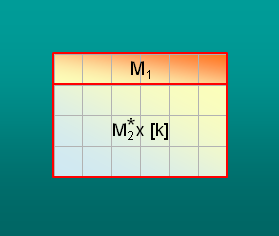 We prove two results on packing common bases of two matroids. First, we show that the
computational problem of common base packing reduces to the special case where one of the
matroids is a partition matroid. Second, we give a counterexample to a conjecture of Chow,
which proposed a sufficient condition for the existence of a common base packing. Chow's
conjecture is a generalization of Rota's basis conjecture.
We prove two results on packing common bases of two matroids. First, we show that the
computational problem of common base packing reduces to the special case where one of the
matroids is a partition matroid. Second, we give a counterexample to a conjecture of Chow,
which proposed a sufficient condition for the existence of a common base packing. Chow's
conjecture is a generalization of Rota's basis conjecture.
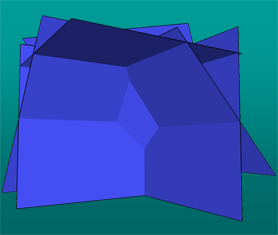 Submodular functions are a key concept in combinatorial optimization.
Algorithms that involve submodular functions usually assume that they are given by
a (value) oracle. Many interesting problems involving
submodular functions can be solved using only polynomially many queries to the oracle,
e.g., exact minimization or approximate maximization.
Submodular functions are a key concept in combinatorial optimization.
Algorithms that involve submodular functions usually assume that they are given by
a (value) oracle. Many interesting problems involving
submodular functions can be solved using only polynomially many queries to the oracle,
e.g., exact minimization or approximate maximization.
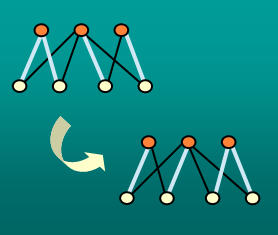 Reconfiguration problems arise when we wish to find a step-by-step
transformation between two feasible solutions of a problem such
that all intermediate results are also feasible. We demonstrate that a
host of reconfiguration problems derived from NP-complete problems
are PSPACE-complete, while some are also NP-hard to approximate. In
contrast, several reconfiguration versions of problems in P are solvable
in polynomial time.
Reconfiguration problems arise when we wish to find a step-by-step
transformation between two feasible solutions of a problem such
that all intermediate results are also feasible. We demonstrate that a
host of reconfiguration problems derived from NP-complete problems
are PSPACE-complete, while some are also NP-hard to approximate. In
contrast, several reconfiguration versions of problems in P are solvable
in polynomial time.
 We conclude a sequence of work by giving near-optimal sketching and streaming algorithms for
estimating Shannon entropy in the most general streaming model,
with arbitrary insertions and deletions.
This improves on prior results that obtain suboptimal space bounds in the general model,
and near-optimal bounds in the insertion-only model without sketching.
Our high-level approach is simple:
we give algorithms to estimate Rényi and Tsallis entropy,
and use them to extrapolate an estimate of Shannon entropy.
The accuracy of our estimates is proven using approximation theory arguments and
extremal properties of Chebyshev polynomials,
a technique which may be useful for other problems.
Our work also yields the best-known and near-optimal additive approximations for entropy,
and hence also for conditional entropy and mutual information.
We conclude a sequence of work by giving near-optimal sketching and streaming algorithms for
estimating Shannon entropy in the most general streaming model,
with arbitrary insertions and deletions.
This improves on prior results that obtain suboptimal space bounds in the general model,
and near-optimal bounds in the insertion-only model without sketching.
Our high-level approach is simple:
we give algorithms to estimate Rényi and Tsallis entropy,
and use them to extrapolate an estimate of Shannon entropy.
The accuracy of our estimates is proven using approximation theory arguments and
extremal properties of Chebyshev polynomials,
a technique which may be useful for other problems.
Our work also yields the best-known and near-optimal additive approximations for entropy,
and hence also for conditional entropy and mutual information.
 We consider the number of queries needed to solve the matroid
intersection problem, a question raised by Welsh (1976). Given two
matroids of rank r on n elements, it is known that O(nr1.5)
independence queries suffice. However, no non-trivial lower bounds are
known for this problem.
We consider the number of queries needed to solve the matroid
intersection problem, a question raised by Welsh (1976). Given two
matroids of rank r on n elements, it is known that O(nr1.5)
independence queries suffice. However, no non-trivial lower bounds are
known for this problem.
 We consider the problem of solving a symmetric, positive definite system of linear equations.
The most well-known and widely-used method for solving such systems
is the preconditioned Conjugate Gradient method.
The performance of this method depends crucially on knowing a good preconditioner matrix.
We show that the Conjugate Gradient method itself can
produce good preconditioners as a by-product.
These preconditioners allow us to derive new asymptotic bounds on the time
to solve multiple related linear systems.
We consider the problem of solving a symmetric, positive definite system of linear equations.
The most well-known and widely-used method for solving such systems
is the preconditioned Conjugate Gradient method.
The performance of this method depends crucially on knowing a good preconditioner matrix.
We show that the Conjugate Gradient method itself can
produce good preconditioners as a by-product.
These preconditioners allow us to derive new asymptotic bounds on the time
to solve multiple related linear systems.
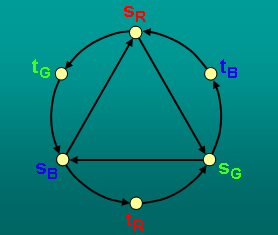 We consider the multi-source network coding problem in cyclic
networks. This problem involves several difficulties not found in
acyclic networks, due to additional causality requirements. This
paper highlights the difficulty of these causality conditions by
analyzing two example cyclic networks. The networks appear quite
similar at first glance, and indeed both have invalid rate-1
network codes that violate causality. However, the two networks
are actually quite different: one also has a valid rate-1 network
code obeying causality, whereas the other does not. This
unachievability result is proven by a new information inequality
for causal coding schemes in a simple cyclic network.
We consider the multi-source network coding problem in cyclic
networks. This problem involves several difficulties not found in
acyclic networks, due to additional causality requirements. This
paper highlights the difficulty of these causality conditions by
analyzing two example cyclic networks. The networks appear quite
similar at first glance, and indeed both have invalid rate-1
network codes that violate causality. However, the two networks
are actually quite different: one also has a valid rate-1 network
code obeying causality, whereas the other does not. This
unachievability result is proven by a new information inequality
for causal coding schemes in a simple cyclic network.
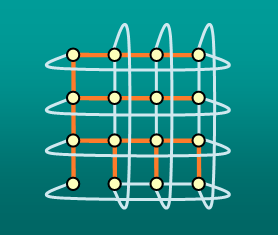 We consider the problem of detecting network faults. Our focus is on detection schemes that send
probes both proactively and non-adaptively. Such schemes are particularly relevant to all-optical
networks, due to these networks' operational characteristics and strict performance requirements.
This fault diagnosis problem motivates a new technical framework that we introduce: group testing
with graph-based constraints. Using this framework, we develop several new probing schemes to detect
network faults. The efficiency of our schemes often depends on the network topology; in many cases
we can show that our schemes are optimal or near-optimal by providing tight lower bounds.
We consider the problem of detecting network faults. Our focus is on detection schemes that send
probes both proactively and non-adaptively. Such schemes are particularly relevant to all-optical
networks, due to these networks' operational characteristics and strict performance requirements.
This fault diagnosis problem motivates a new technical framework that we introduce: group testing
with graph-based constraints. Using this framework, we develop several new probing schemes to detect
network faults. The efficiency of our schemes often depends on the network topology; in many cases
we can show that our schemes are optimal or near-optimal by providing tight lower bounds.
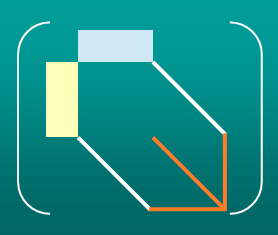 We present a new algebraic algorithm for the classical problem of weighted matroid intersection.
This problem generalizes numerous well-known problems,
such as bipartite matching, network flow, etc.
Our algorithm has running time O(nr^{w-1} W^{1+eps}) for linear matroids
with n elements and rank r,
where w is the matrix multiplication exponent,
and W denotes the maximum weight of any element.
This algorithm is the fastest known when W is small.
Our approach builds on the recent work of Sankowski (2006)
for Weighted Bipartite Matching
and Harvey (2006) for Unweighted Linear Matroid Intersection.
We present a new algebraic algorithm for the classical problem of weighted matroid intersection.
This problem generalizes numerous well-known problems,
such as bipartite matching, network flow, etc.
Our algorithm has running time O(nr^{w-1} W^{1+eps}) for linear matroids
with n elements and rank r,
where w is the matrix multiplication exponent,
and W denotes the maximum weight of any element.
This algorithm is the fastest known when W is small.
Our approach builds on the recent work of Sankowski (2006)
for Weighted Bipartite Matching
and Harvey (2006) for Unweighted Linear Matroid Intersection.
 We present new algebraic approaches for several well-known combinatorial problems,
including non-bipartite matching, matroid intersection, and some of their generalizations.
Our work yields new randomized algorithms that are the most efficient known.
For non-bipartite matching, we obtain a simple, purely algebraic algorithm with running time
O(nω) where n is the number of vertices
and ω is the matrix multiplication exponent.
This resolves the central open problem of Mucha and Sankowski (FOCS 2004).
For matroid intersection, our algorithm has running time O(nrω-1)
for matroids with n elements and rank r that satisfy some natural conditions.
We present new algebraic approaches for several well-known combinatorial problems,
including non-bipartite matching, matroid intersection, and some of their generalizations.
Our work yields new randomized algorithms that are the most efficient known.
For non-bipartite matching, we obtain a simple, purely algebraic algorithm with running time
O(nω) where n is the number of vertices
and ω is the matrix multiplication exponent.
This resolves the central open problem of Mucha and Sankowski (FOCS 2004).
For matroid intersection, our algorithm has running time O(nrω-1)
for matroids with n elements and rank r that satisfy some natural conditions.
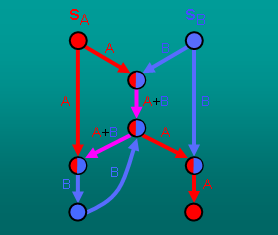 Motivated by practical networking scenarios, we introduce a notion of restricted communication
called "conservative networking". Consider a network of lossless links and a number of independent
sources. Each node needs to recover a certain subset of the sources. However, each node is
"conservative" in that all information it receives can only be a function of the sources it will
ultimately recover. For acyclic networks, we show that conservative networking admits a clean
characterization: (i) The rates achievable by integer routing, factional routing, and network coding
are equal, and (ii) this rate is determined by a simple cut bound. However, this clean
characterization does not extend to cyclic networks. We present cyclic examples showing that (i)
fractional routing can be strictly better than integer routing, (ii) network coding can be strictly
better than fractional routing, and (iii) the cut bound cannot be achieved in general. This work
underscores the difficulties generally encountered in cyclic networks.
Motivated by practical networking scenarios, we introduce a notion of restricted communication
called "conservative networking". Consider a network of lossless links and a number of independent
sources. Each node needs to recover a certain subset of the sources. However, each node is
"conservative" in that all information it receives can only be a function of the sources it will
ultimately recover. For acyclic networks, we show that conservative networking admits a clean
characterization: (i) The rates achievable by integer routing, factional routing, and network coding
are equal, and (ii) this rate is determined by a simple cut bound. However, this clean
characterization does not extend to cyclic networks. We present cyclic examples showing that (i)
fractional routing can be strictly better than integer routing, (ii) network coding can be strictly
better than fractional routing, and (iii) the cut bound cannot be achieved in general. This work
underscores the difficulties generally encountered in cyclic networks.
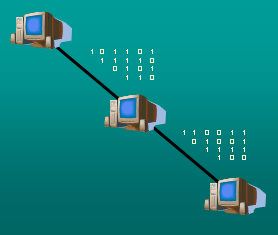 Random linear network coding is a capacity-achieving
communication scheme for single sessions over lossy
wireline or wireless packet networks. From the point
of view of efficiently utilizing transmissions,
random linear network coding is an attractive strategy.
However, it is not presently attractive from the point of
view
of efficiently utilizing computational resources. A natural
code design question arises: can we design a network code
that preserves the communication efficiency of a random
linear code and achieves better computational efficiency?
In this paper, we give an affirmative answer to this
question.
Random linear network coding is a capacity-achieving
communication scheme for single sessions over lossy
wireline or wireless packet networks. From the point
of view of efficiently utilizing transmissions,
random linear network coding is an attractive strategy.
However, it is not presently attractive from the point of
view
of efficiently utilizing computational resources. A natural
code design question arises: can we design a network code
that preserves the communication efficiency of a random
linear code and achieves better computational efficiency?
In this paper, we give an affirmative answer to this
question.
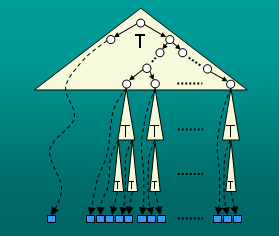 We prove nearly tight lower bounds on the number of rounds of communication
required by efficient protocols over asymmetric channels between
a server (with high sending capacity) and one or more clients
(with low sending capacity). This scenario captures the common
asymmetric communication bandwidth between broadband Internet providers
and home users, as well as sensor networks where sensors (clients)
have limited capacity because of the high power requirements for
long-range transmissions.
An efficient protocol in this setting
communicates n bits from each of the k clients to
the server, where the clients' bits are sampled from a joint distribution D
that is known to the server but not the clients,
with the clients sending only O(H(D)+k)
bits total, where H(D) is the entropy of distribution D.
In the single-client case, there are efficient protocols using O(1) rounds
in expectation and O(lg n) rounds in the worst case.
We prove that this is essentially best possible: with probability
1/2^O(t lg t), any efficient protocol can be forced to use t rounds.
In the multi-client case, there are efficient protocols using O(lg k)
rounds in expectation.
We prove that this is essentially best possible: with probability Omega(1),
any efficient protocol can be forced to use Omega(lg k / lg lg k)
rounds.
Along the way, we develop new techniques of independent interest
for proving lower bounds in communication complexity.
We prove nearly tight lower bounds on the number of rounds of communication
required by efficient protocols over asymmetric channels between
a server (with high sending capacity) and one or more clients
(with low sending capacity). This scenario captures the common
asymmetric communication bandwidth between broadband Internet providers
and home users, as well as sensor networks where sensors (clients)
have limited capacity because of the high power requirements for
long-range transmissions.
An efficient protocol in this setting
communicates n bits from each of the k clients to
the server, where the clients' bits are sampled from a joint distribution D
that is known to the server but not the clients,
with the clients sending only O(H(D)+k)
bits total, where H(D) is the entropy of distribution D.
In the single-client case, there are efficient protocols using O(1) rounds
in expectation and O(lg n) rounds in the worst case.
We prove that this is essentially best possible: with probability
1/2^O(t lg t), any efficient protocol can be forced to use t rounds.
In the multi-client case, there are efficient protocols using O(lg k)
rounds in expectation.
We prove that this is essentially best possible: with probability Omega(1),
any efficient protocol can be forced to use Omega(lg k / lg lg k)
rounds.
Along the way, we develop new techniques of independent interest
for proving lower bounds in communication complexity.
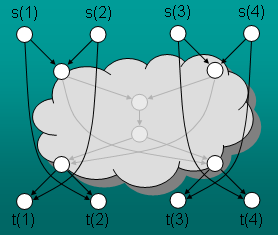 We consider the capacity of information networks in the absence of interference and noise.
An outer bound on the rate region of these networks is presented,
answering a question of Song, Yeung and Cai.
This outer bound combines
properties of entropy with a strong information inequality
derived from the structure of the network. This blend of information
theoretic and graph theoretic arguments generates many interesting results.
For example, we exactly characterize the capacity of directed
cycles, solving a question of Kramer and Savari.
We also give the first known proof of a gap between the sparsity of an
undirected graph and its capacity.
Extending this result, we show that multicommodity flow solutions achieve the capacity
in an infinite class of undirected graphs, thereby making important
progress on a conjecture of Li and Li. This result is in sharp
contrast to the situation with directed graphs, where we present a family of graphs
in which the gap between the capacity and the rate achievable using
multicommodity flows is linear in the size of the graph.
We consider the capacity of information networks in the absence of interference and noise.
An outer bound on the rate region of these networks is presented,
answering a question of Song, Yeung and Cai.
This outer bound combines
properties of entropy with a strong information inequality
derived from the structure of the network. This blend of information
theoretic and graph theoretic arguments generates many interesting results.
For example, we exactly characterize the capacity of directed
cycles, solving a question of Kramer and Savari.
We also give the first known proof of a gap between the sparsity of an
undirected graph and its capacity.
Extending this result, we show that multicommodity flow solutions achieve the capacity
in an infinite class of undirected graphs, thereby making important
progress on a conjecture of Li and Li. This result is in sharp
contrast to the situation with directed graphs, where we present a family of graphs
in which the gap between the capacity and the rate achievable using
multicommodity flows is linear in the size of the graph.
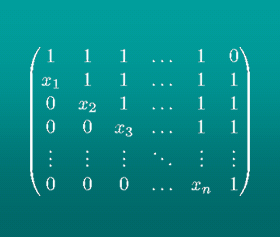 Given a matrix whose entries are a mixture
of numeric values and symbolic variables, the
matrix completion problem is to assign values to the
variables so as to maximize the resulting matrix rank.
This problem has deep connections to computational complexity
and numerous important algorithmic applications.
Determining the complexity of this problem is a
fundamental open question in computational complexity.
Under different settings of parameters, the problem is variously in P, in RP, or NP-hard.
We shed new light on this landscape by demonstrating a new region of NP-hard scenarios.
As a special case, we obtain the first known hardness result for matrices in which each variable
appears only twice.
Given a matrix whose entries are a mixture
of numeric values and symbolic variables, the
matrix completion problem is to assign values to the
variables so as to maximize the resulting matrix rank.
This problem has deep connections to computational complexity
and numerous important algorithmic applications.
Determining the complexity of this problem is a
fundamental open question in computational complexity.
Under different settings of parameters, the problem is variously in P, in RP, or NP-hard.
We shed new light on this landscape by demonstrating a new region of NP-hard scenarios.
As a special case, we obtain the first known hardness result for matrices in which each variable
appears only twice.
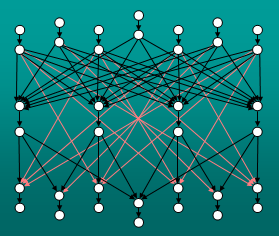 We study the extent to which combinatorial cut conditions
determine the maximum network coding rate of k-pairs
communication problems. We seek a combinatorial
parameter of directed networks which constitutes
a valid upper bound on the network coding rate
but exceeds this rate by only a small factor in
the worst case. (This worst-case ratio is called
the gap of the parameter.) We begin by
considering vertex-sparsity and meagerness,
showing that both of these parameters have a
gap which is linear in the network size. Due
to the weakness of these bounds, we propose a
new bound called informational meagerness.
This bound generalizes both vertex-sparsity and
meagerness and is potentially the first known
combinatorial cut condition with a sublinear
gap. However, we prove that informational
meagerness does not tightly characterize the
network coding rate: its gap can be super-constant.
We study the extent to which combinatorial cut conditions
determine the maximum network coding rate of k-pairs
communication problems. We seek a combinatorial
parameter of directed networks which constitutes
a valid upper bound on the network coding rate
but exceeds this rate by only a small factor in
the worst case. (This worst-case ratio is called
the gap of the parameter.) We begin by
considering vertex-sparsity and meagerness,
showing that both of these parameters have a
gap which is linear in the network size. Due
to the weakness of these bounds, we propose a
new bound called informational meagerness.
This bound generalizes both vertex-sparsity and
meagerness and is potentially the first known
combinatorial cut condition with a sublinear
gap. However, we prove that informational
meagerness does not tightly characterize the
network coding rate: its gap can be super-constant.
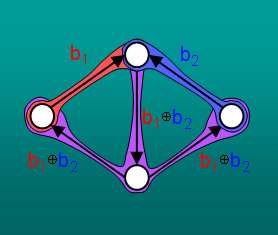 We present a new deterministic algorithm to construct network codes for multicast problems,
a particular class of network information flow problems.
Our algorithm easily generalizes to several variants of multicast problems.
Our approach is based on a new algorithm for maximum-rank completion
of mixed matrices---taking a matrix whose entries are a mixture
of numeric values and symbolic variables, and assigning values to the
variables so as to maximize the resulting matrix rank.
Our algorithm is faster than existing deterministic algorithms and can
operate over a smaller field.
We present a new deterministic algorithm to construct network codes for multicast problems,
a particular class of network information flow problems.
Our algorithm easily generalizes to several variants of multicast problems.
Our approach is based on a new algorithm for maximum-rank completion
of mixed matrices---taking a matrix whose entries are a mixture
of numeric values and symbolic variables, and assigning values to the
variables so as to maximize the resulting matrix rank.
Our algorithm is faster than existing deterministic algorithms and can
operate over a smaller field.
 FUSE is a lightweight failure notification service for building distributed systems. Distributed
systems built with FUSE are guaranteed that failure notifications never fail. Whenever a failure
notification is triggered, all live members of the FUSE group will hear a notification within a
bounded period of time, irrespective of node or communication failures. In contrast to previous
work on failure detection, the responsibility for deciding that a failure has occurred is shared
between the FUSE service and the distributed application. This allows applications to implement
their own definitions of failure. Our experience building a scalable distributed event delivery
system on an overlay network has convinced us of the usefulness of this service. Our results
demonstrate that the network costs of each FUSE group can be small; in particular, our overlay
network implementation requires no additional liveness-verifying ping traffic beyond that already
needed to maintain the overlay, making the steady state network load independent of the number of
active FUSE groups.
FUSE is a lightweight failure notification service for building distributed systems. Distributed
systems built with FUSE are guaranteed that failure notifications never fail. Whenever a failure
notification is triggered, all live members of the FUSE group will hear a notification within a
bounded period of time, irrespective of node or communication failures. In contrast to previous
work on failure detection, the responsibility for deciding that a failure has occurred is shared
between the FUSE service and the distributed application. This allows applications to implement
their own definitions of failure. Our experience building a scalable distributed event delivery
system on an overlay network has convinced us of the usefulness of this service. Our results
demonstrate that the network costs of each FUSE group can be small; in particular, our overlay
network implementation requires no additional liveness-verifying ping traffic beyond that already
needed to maintain the overlay, making the steady state network load independent of the number of
active FUSE groups.
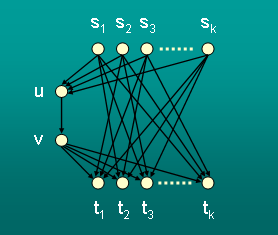 Given a graph G = (V,E) and k source-sink pairs of vertices, this paper investigates the
maximum rate r at which all pairs can simultaneously communicate. We view this problem from two
perspectives and compare their advantages. In the multicommodity flow formulation, a solution
provides dedicated bandwidth r between each source-sink pair. In the information flow
formulation, a vertex can transmit a function of the information it received thereby allowing
multiple source-sink pairs to share bandwidth. For directed acyclic graphs
with n vertices, we show that the rate
achievable in the information flow formulation can be a multiplicative factor n larger than the
rate achievable in the multicommodity flow formulation. It is well known that
for undirected graphs with n vertices, in the multicommodity flow formulation, the maximum rate
achievable can be an O(1/log |V|) multiplicative factor smaller than the value of the
sparsest cut. We extend this result to show that the maximum rate achievable in the information
flow setting can be an O(1/log |V|) multiplicative factor smaller than the sparsest cut value.
For directed acyclic graphs G, we
define a parameter called the value of the most meager cut
which is an upper bound for the maximum rate achievable
in the information flow setting. We also present an example
illustrating that this upper bound is not always tight.
Given a graph G = (V,E) and k source-sink pairs of vertices, this paper investigates the
maximum rate r at which all pairs can simultaneously communicate. We view this problem from two
perspectives and compare their advantages. In the multicommodity flow formulation, a solution
provides dedicated bandwidth r between each source-sink pair. In the information flow
formulation, a vertex can transmit a function of the information it received thereby allowing
multiple source-sink pairs to share bandwidth. For directed acyclic graphs
with n vertices, we show that the rate
achievable in the information flow formulation can be a multiplicative factor n larger than the
rate achievable in the multicommodity flow formulation. It is well known that
for undirected graphs with n vertices, in the multicommodity flow formulation, the maximum rate
achievable can be an O(1/log |V|) multiplicative factor smaller than the value of the
sparsest cut. We extend this result to show that the maximum rate achievable in the information
flow setting can be an O(1/log |V|) multiplicative factor smaller than the sparsest cut value.
For directed acyclic graphs G, we
define a parameter called the value of the most meager cut
which is an upper bound for the maximum rate achievable
in the information flow setting. We also present an example
illustrating that this upper bound is not always tight.
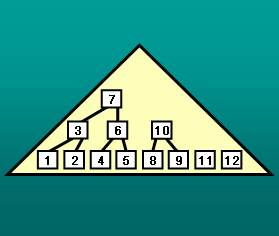 We propose the post-order heap, a new data structure for implementing priority queues. Our structure
is a simple variant of the binary heap that requires only O(1) amortized time for Insert operations
and O(log n) time in the worst case for Delete-Min operations. Like the binary heap, the post-order
heap is an implicit data structure, meaning that a structure containing n elements can be stored
using only the first n locations of an array and O(1) additional words of storage.
We propose the post-order heap, a new data structure for implementing priority queues. Our structure
is a simple variant of the binary heap that requires only O(1) amortized time for Insert operations
and O(log n) time in the worst case for Delete-Min operations. Like the binary heap, the post-order
heap is an implicit data structure, meaning that a structure containing n elements can be stored
using only the first n locations of an array and O(1) additional words of storage.
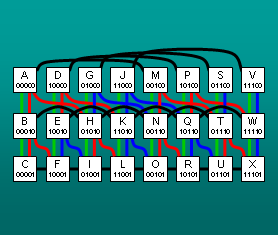 We consider the problem of storing an ordered dictionary data structure over a distributed set of
nodes. In contrast to traditional sequential data structures, distributed data structures should
ideally have low congestion. We present a novel randomized data structure, called a family tree, to
solve this problem. A family tree has optimal expected congestion, uses only a constant amount of
state per node, and supports searches and node insertion/deletion in expected O(log n) time on a
system with n nodes. Furthermore, a family tree supports keys from any ordered domain. Because the
keys are not hashed, searches have good locality in the sense that intermediate nodes on the search
path have keys that are not far outside of the range between the source and destination.
We consider the problem of storing an ordered dictionary data structure over a distributed set of
nodes. In contrast to traditional sequential data structures, distributed data structures should
ideally have low congestion. We present a novel randomized data structure, called a family tree, to
solve this problem. A family tree has optimal expected congestion, uses only a constant amount of
state per node, and supports searches and node insertion/deletion in expected O(log n) time on a
system with n nodes. Furthermore, a family tree supports keys from any ordered domain. Because the
keys are not hashed, searches have good locality in the sense that intermediate nodes on the search
path have keys that are not far outside of the range between the source and destination.
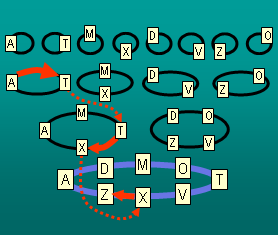
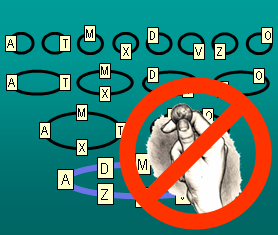 We present a deterministic scalable overlay network. In contrast, most previous overlays use
randomness or hashing (pseudo-randomness) to achieve a uniform distribution of data and routing
traffic.
We present a deterministic scalable overlay network. In contrast, most previous overlays use
randomness or hashing (pseudo-randomness) to achieve a uniform distribution of data and routing
traffic.
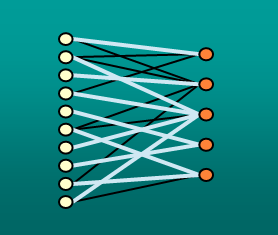 We consider the problem of fairly matching the left-hand vertices of a bipartite graph to the
right-hand vertices. We refer to this problem as the semi-matching problem; it is a relaxation of
the known bipartite matching problem. We present a way to evaluate the quality of a given
semi-matching and show that, under this measure, an optimal semi-matching balances the load on the
right hand vertices with respect to any Lp-norm. In particular, when modeling a job assignment
system, an optimal semi-matching achieves the minimal makespan and the minimal flow time for the
system.
We consider the problem of fairly matching the left-hand vertices of a bipartite graph to the
right-hand vertices. We refer to this problem as the semi-matching problem; it is a relaxation of
the known bipartite matching problem. We present a way to evaluate the quality of a given
semi-matching and show that, under this measure, an optimal semi-matching balances the load on the
right hand vertices with respect to any Lp-norm. In particular, when modeling a job assignment
system, an optimal semi-matching achieves the minimal makespan and the minimal flow time for the
system.
 Scalable overlay networks such as Chord, CAN, Pastry, and Tapestry have recently emerged as flexible infrastructure for building large peer-to-peer systems. In practice, such systems have two disadvantages: They provide no control over where data is stored and no guarantee that routing paths remain within an administrative domain whenever possible. SkipNet is a scalable overlay network that provides controlled data placement and guaranteed routing locality by organizing data primarily by string names. SkipNet allows for both fine-grained and coarse-grained control over data placement: Content can be placed either on a pre-determined node or distributed uniformly across the nodes of a hierarchical naming subtree. An additional useful consequence of SkipNet's locality properties is that partition failures, in which an entire organization disconnects from the rest of the system, can result in two disjoint, but well-connected overlay networks.
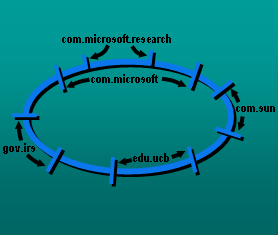 SkipNet is a scalable overlay network that provides controlled data placement and routing locality
guarantees by organizing data primarily by lexicographic ordering of string names. A key side-effect
of the SkipNet design is that all nodes from an organization form one or a few contiguous overlay
segments. When an entire organization disconnects from the rest of the system, repair of only a few
pointers quickly enables efficient routing throughout the disconnected organization; full repair is
done as a subsequent background task. These same operations can be later used to efficiently
reconnect an organization's SkipNet back into the global one.
SkipNet is a scalable overlay network that provides controlled data placement and routing locality
guarantees by organizing data primarily by lexicographic ordering of string names. A key side-effect
of the SkipNet design is that all nodes from an organization form one or a few contiguous overlay
segments. When an entire organization disconnects from the rest of the system, repair of only a few
pointers quickly enables efficient routing throughout the disconnected organization; full repair is
done as a subsequent background task. These same operations can be later used to efficiently
reconnect an organization's SkipNet back into the global one.