
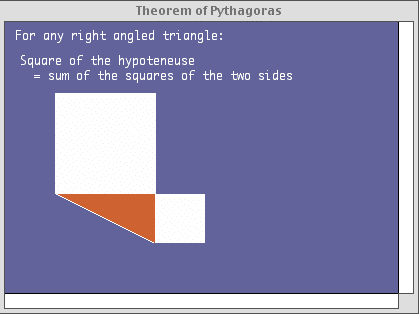
The theorem states that the area of the large white square (square of the hypoteneuse)
in the following diagram
|
|
|
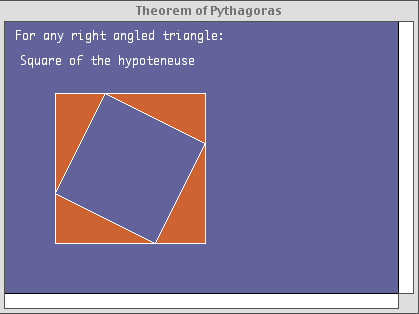
The proof begins by changing the solid white square to a blue one outlined in white. Then the same orange triangle is placed at each side of the square.
The inside edges of the four triangles form the hypoteneus square.
The outside edges of these four triangles form a large outer square.
|
The outer square has fixed area equal to the area of the blue hypoteneuse square plus the areas of all four orange triangles.
As the orange triangles move about in the animation, the outer square is preserved and consequently, the area of the outer square does not change.
Because the orange triangles never overlap in the animation, the total area of the four triangles does not change either.
This means then that the blue area inside the large outer square stays the same! (Since it is just the difference between the area of the outer square and the area of all four orange triangles.)
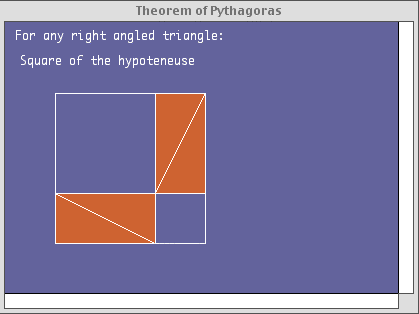
So, when the triangles finally arrive in the following position
|
But the blue part is now exactly the two squares formed by the sides of the original triangle!
This shows how it is that the area of the square of the hypoteneuse equals the sum of the areas of the squares of the sides of a right angled triangle. And that is a demonstration of a proof.
Author: R.W. Oldford June 13, 2001.