Wave motion is the physical mechanism by which energy and momentum can be transported over a long distance without transporting mass a corresponding distance; think of hearing a dog bark across a mountain valley. As such it is an old and well developed part of physics and applied mathematics with a great deal that has been passed down from one generation of scientists to the next without much change. The wiki pages linked above discuss some of the classical ideas in great detail, here I make two comments relating to some of the ideas often under-appreciated in classical theories.
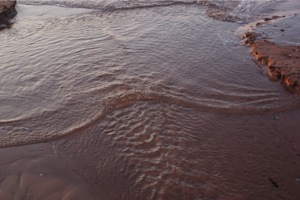
First of all, waves rarely exist in isolation. In the picture above a small creek is flowing out into the sea from the bottom of the picture, upward and to the left. From the top of the picture small waves propagate downward onto the beach. As they reach the creek bed, the region of strong currents slows the waves and causes energy to build up. This can be seen near the center of the picture where a bit of breaking can even be seen. Waves can thus have their wavelengths and amplitudes changed by a background current.
Second of all, the vast majority of waves in Nature are dispersive. This means that waves of different lengths travel at different speeds and that the energy carried by the waves moves at a different speed than the individual wave crests. Dispersive waves are often overlooked in the applied mathematics curriculum because linear dispersive wave equations generally do not admit closed form solutions the way that the classical wave equation does.
Wave Motion