In contrast to particle mechanics, continuum mechanics considers the forces between neighbouring particles. The unique force due to neighbours is called the traction or the contact force. It has the rather strange mathematical property that is depends not just on position, but also on what part of the continuum is considered to be the outside and what part is considered the inside. Mathematically this means that the traction force vector is a function of one position vector and a second vector, the local unit normal. This is in contrast to body forces like gravity and Coulomb’s force in electricity and magnetism which depend on position only.
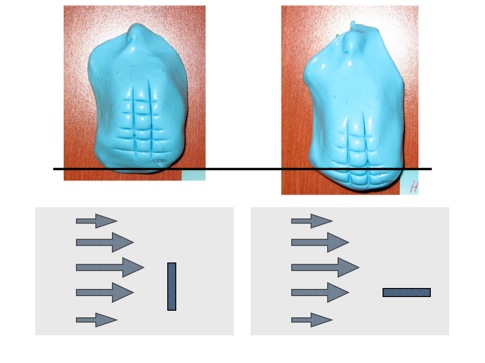
In the upper two pictures above we have a picture of silly putty stuck to a cabinet in our lab and allowed to slump under gravity. We etched a small grid on the surface of the silly putty. The silly putty “flows” slowly and the grid shows some of the complicated response to the imposed body force of gravity. In particular the vertical lines look to be squeezed together at the back of the drop and apart at the front of the drop.
In the lower two pictures we show a schematic of just why traction depends on orientation. We consider flow between two plates which is known to give the fastest speeds at the center of the gap, and slower speeds closer to the walls. A small stick is oriented vertically in the left panel and horizontally in the right panel. In the left panel the stick would experience a strong force at its upper end and a weaker force at its lower end. It would thus move from left to right and also rotate about its center of mass. In the right panel the horizontally oriented stick would move left to right with a single speed. You can also think of a sail oriented perpendicular to the wind driving a boat’s motion, as opposed to the same sail oriented parallel to the wind direction not driving the boat to move at all.
To express this in a mathematically correct manner we need a way to re-express the traction vector in terms of a more complicated mathematical object that is a function of space only. It turns out to be a Cartesian tensor called the stress tensor.
Stress