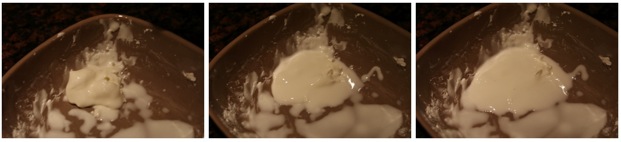
Non-Newtonian fluids, somewhat loosely, are fluids that exhibit solid-like properties. More technically the stress in the fluid is no longer proportional to the rate of strain (in the tensor sense). In the above pictures we first put cornstarch powder in a bowl, then added water spoonful by spoonful, mixing as best we could with each bit of water added. We then scooped the material out and dropped it into the bowl shown above. In the picture on the left the material had just dropped and looks almost like a white rock. We then took pictures every ten seconds, showing only every second one. After twenty seconds (middle picture) the “rock” from the picture has begun to melt and the mixture looks kind of like an egg. Twenty seconds later there is essentially no sign of the rock and the material looks like a puddle. Technically one would say that the cornstarch mixture behaves like a solid in response to fast time scale forcing, and as a fluid to slow time scale forcing. A nice demonstration of this that is hard to show in pictures, is to take a puddle like in the rightmost picture and smack it with your hand (not too hard). Your hand feels basically as if it had hit a solid wall. If, on the other hand, you rest your hand on the cornstarch, the weight of the hand gradually lets it sink into the cornstarch. Cornstarch is thus called a shear thickening fluid.
An example of a shear thinning fluid is paint. Paint is shear thinning by design, allowing you to brush, or roller, it onto the wall, but keeping it from dripping on your floor when it is drying.
Non-Newtonian fluids exhibit their strange properties because of the micro-structure they have. In some cases this structure is quite sensitive. For example take the cornstarch mixture in the pictures and add three more spoonfuls of water and mix. The result is basically, white muddy water which, when subjected to lab tests, would be found to be very close to a Newtonian fluid. In some ways it is surprising that the continuum theory of fluids is so readily modified to account for microstructure. Indeed practical material theories walk a fine line between realism and a reasonable number of parameters, and many modern theories attempt to model both the large, continuum scales and some aspects of the microstructure (e.g. microrheology).
Non-Newtonian Fluids