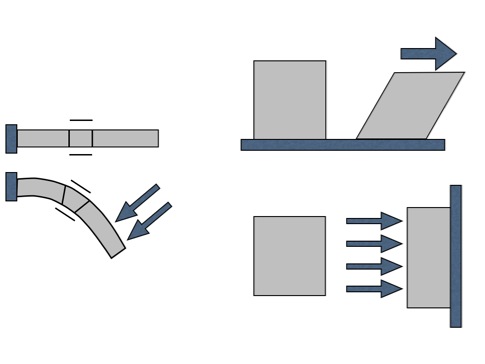
Deformation, mathematically measures the difference in the distance between neighbouring points before and after an object is subjected to an external force. Consider the rod on the left of the figure above. As it is bent the rectangle identified in the middle of it is bent into a different shape. The length of the line segment along the top of the bent rod is longer than the length of the line segment along the top of the unbent rod. Similarly the length of the line segment along the bottom of the bent rod is shorter than the length of the line segment along the bottom of the unbent rod. I have included the line segments from the unbent rod beside the picture of the bent rod so you can confirm the change in length yourself.
In three dimensional space three neighbouring points can have their mutual orientation changed in a variety of ways. On the right of the figure I show the schematic for the two basic forms of deformation that are easily realized in a laboratory: shear (above) and compression (below) . The upper picture shows a rectangle with a fixed bottom. When a horizontal force is imposed along the top, the rectangle becomes a parallelogram. Moreover, since many solids very nearly conserve volume the height of the rectangle decreases slightly (I have exaggerated this in the picture). When the rectangle is compressed from left to right, with a fixed wall on the right side of the rectangle it compresses in the horizontal. Again, since most elastic materials nearly conserve volume some of the compression is counteracted by spreading in the vertical direction.
Describing this mathematically in general and without reference to coordinates is the job of Cartesian tensors.
Deformation