| Learning Submodular Functions | 2011/06 | |
| Maria-Florina Balcan, Nicholas J. A. Harvey. 43rd Annual ACM Symposium on Theory of Computing (STOC 11), San Jose, CA, June 2011. PDF. arXiv, August 2010. PDF.
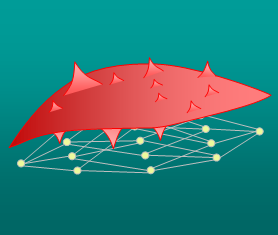
A problem instance consists of a distribution on {0,1}n and a real-valued function on {0,1}n that is non-negative, monotone and submodular. We are given poly(n) samples from this distribution, along with the values of the function at those sample points. The task is to approximate the value of the function to within a multiplicative factor at subsequent sample points drawn from the same distribution, with sufficiently high probability. We prove several results for this problem.
Our work combines central issues in optimization (submodular functions and matroids) with central topics in learning (distributional learning and PAC-style analyses) and with central concepts in pseudorandomness (lossless expander graphs). Our analysis involves a twist on the usual learning theory models and uncovers some interesting structural and extremal properties of submodular functions, which we suspect are likely to be useful in other contexts. In particular, to prove our general lower bound, we use lossless expanders to construct a new family of matroids which can take wildly varying rank values on superpolynomially many sets; no such construction was previously known. | ||
| Keywords: Learning Theory, Submodular Functions, Matroids | ||
 There has recently been significant interest in the machine learning community on understanding
and using submodular functions. Despite this recent interest, little is known about submodular functions
from a learning theory perspective. Motivated by applications such as pricing goods in economics, this
paper considers PAC-style learning of submodular functions in a distributional setting.
There has recently been significant interest in the machine learning community on understanding
and using submodular functions. Despite this recent interest, little is known about submodular functions
from a learning theory perspective. Motivated by applications such as pricing goods in economics, this
paper considers PAC-style learning of submodular functions in a distributional setting.
In 2009, Chekuri and Vondrak also proved a concentration inequality for Lipschitz, monotone submodular functions, using the FKG inequality. Their inequality achieves Chernoff-type concentration, which is somewhat better than the Talagrand-like concentration that we achieve. An earlier version of our paper only proved concentration for matroid rank functions. After learning of the work of Chekuri and Vondrak, we improved our inequality to its current form, in which it applies to arbitrary Lipschitz, monotone, submodular functions.
Perhaps the nicest way to prove such inequalities is using self-bounding functions. In particular, this approach yields concentration for non-monotone functions; it is not clear whether the FKG or Talagrand approaches do too. See the note by Vondrak from 2010.
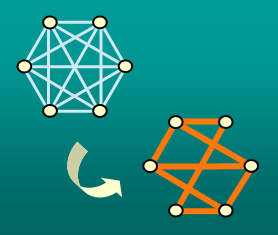 We present two new approaches to constructing graph sparsifiers -- weighted subgraphs
for which every cut has the same value as the original graph, up to a factor of (1 ± ε).
The first approach independently samples each edge uv with probability
inversely proportional to the edge-connectivity between u and v.
The fact that this approach produces a sparsifier resolves an open question
of Benczur and Karger.
Concurrent work of Hariharan and Panigrahi (2010) also resolves this question.
The second approach samples uniformly random spanning trees.
Both of our approaches produce sparsifiers with
O(n log2(n)/ε2) edges.
Our proofs are based on extensions of the Karger-Stein contraction algorithm
which allow it to compute minimum "Steiner cuts".
We present two new approaches to constructing graph sparsifiers -- weighted subgraphs
for which every cut has the same value as the original graph, up to a factor of (1 ± ε).
The first approach independently samples each edge uv with probability
inversely proportional to the edge-connectivity between u and v.
The fact that this approach produces a sparsifier resolves an open question
of Benczur and Karger.
Concurrent work of Hariharan and Panigrahi (2010) also resolves this question.
The second approach samples uniformly random spanning trees.
Both of our approaches produce sparsifiers with
O(n log2(n)/ε2) edges.
Our proofs are based on extensions of the Karger-Stein contraction algorithm
which allow it to compute minimum "Steiner cuts".
 We conclude a sequence of work by giving near-optimal sketching and streaming algorithms for
estimating Shannon entropy in the most general streaming model,
with arbitrary insertions and deletions.
This improves on prior results that obtain suboptimal space bounds in the general model,
and near-optimal bounds in the insertion-only model without sketching.
Our high-level approach is simple:
we give algorithms to estimate Rényi and Tsallis entropy,
and use them to extrapolate an estimate of Shannon entropy.
The accuracy of our estimates is proven using approximation theory arguments and
extremal properties of Chebyshev polynomials,
a technique which may be useful for other problems.
Our work also yields the best-known and near-optimal additive approximations for entropy,
and hence also for conditional entropy and mutual information.
We conclude a sequence of work by giving near-optimal sketching and streaming algorithms for
estimating Shannon entropy in the most general streaming model,
with arbitrary insertions and deletions.
This improves on prior results that obtain suboptimal space bounds in the general model,
and near-optimal bounds in the insertion-only model without sketching.
Our high-level approach is simple:
we give algorithms to estimate Rényi and Tsallis entropy,
and use them to extrapolate an estimate of Shannon entropy.
The accuracy of our estimates is proven using approximation theory arguments and
extremal properties of Chebyshev polynomials,
a technique which may be useful for other problems.
Our work also yields the best-known and near-optimal additive approximations for entropy,
and hence also for conditional entropy and mutual information.
 We present new algebraic approaches for several well-known combinatorial problems,
including non-bipartite matching, matroid intersection, and some of their generalizations.
Our work yields new randomized algorithms that are the most efficient known.
For non-bipartite matching, we obtain a simple, purely algebraic algorithm with running time
O(nω) where n is the number of vertices
and ω is the matrix multiplication exponent.
This resolves the central open problem of Mucha and Sankowski (FOCS 2004).
For matroid intersection, our algorithm has running time O(nrω-1)
for matroids with n elements and rank r that satisfy some natural conditions.
We present new algebraic approaches for several well-known combinatorial problems,
including non-bipartite matching, matroid intersection, and some of their generalizations.
Our work yields new randomized algorithms that are the most efficient known.
For non-bipartite matching, we obtain a simple, purely algebraic algorithm with running time
O(nω) where n is the number of vertices
and ω is the matrix multiplication exponent.
This resolves the central open problem of Mucha and Sankowski (FOCS 2004).
For matroid intersection, our algorithm has running time O(nrω-1)
for matroids with n elements and rank r that satisfy some natural conditions.
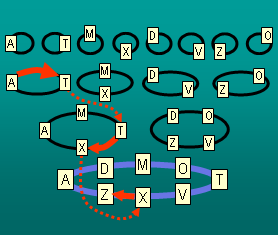 Scalable overlay networks such as Chord, CAN, Pastry, and Tapestry have recently emerged as flexible infrastructure for building large peer-to-peer systems. In practice, such systems have two disadvantages: They provide no control over where data is stored and no guarantee that routing paths remain within an administrative domain whenever possible. SkipNet is a scalable overlay network that provides controlled data placement and guaranteed routing locality by organizing data primarily by string names. SkipNet allows for both fine-grained and coarse-grained control over data placement: Content can be placed either on a pre-determined node or distributed uniformly across the nodes of a hierarchical naming subtree. An additional useful consequence of SkipNet's locality properties is that partition failures, in which an entire organization disconnects from the rest of the system, can result in two disjoint, but well-connected overlay networks.